Every securities licensing exam — what it covers, who needs it, and how to pass it first attempt.
Click any exam to see the full breakdown: benefits, career pathway, salary data, why candidates fail, and the course that gets you through it. GreenLight Guarantee on everything.
400,000+
students licensed since 1996
GreenLight
Money-Back Guarantee ™
TotalGenius
AI Tutoring available 24/7
877-218-1776
click-to-call
Which license does your role actually need?
The exam your role requires depends on what you'll be selling or advising on — and how your compensation is structured. Here's the plain-English guide. Use the exam selector above to configure this page for your specific exam.
I work in a bank's investment center selling mutual funds and variable annuities. Which exam do I need?
Series 6 — the Investment Company and Variable Contracts Products Representative license. It covers exactly the product set most bank investment center reps sell. Your bank will also require the Series 63 for state registration, so the Series 6 + 63 combination is the most common path for this role.
I want to sell individual stocks and bonds as well as funds. Which exam do I need?
Series 7 — the General Securities Representative license. It gives you the broadest scope of any FINRA representative exam: equities, debt, options, mutual funds, variable products, municipal securities, and more. Most broker-dealers affiliated with a bank will sponsor new advisors for the Series 7 path.
I want to charge a management fee rather than earn commissions. Which exam do I need?
Series 65 — the Uniform Investment Adviser Law Examination. It qualifies you as an Investment Adviser Representative (IAR) for fee-based advisory services. No broker-dealer sponsorship is required to sit for the Series 65, making it the most accessible path for banking professionals transitioning to independent advisory roles.
I already hold the Series 7. What do I need to give fee-based advice as well?
Series 66 — the Uniform Combined State Law Examination. It combines the Series 63 (state agent registration) and Series 65 (investment adviser law) into one exam, specifically designed for candidates who already hold the Series 7. The pass threshold (75%) is higher than either exam alone.
Does my banking experience count toward any prerequisites?
For the Series 6, Series 7, and Series 66, your firm must sponsor you — but no experience prerequisite applies to the Series 6 or 7 beyond the SIE (which may or may not be required depending on when you’re registering). The Series 65 has no sponsorship or experience requirement at all — anyone can sit for it.
What you already know covers more of the exam than you think.
Banking professionals consistently score better on their first securities exam than candidates from other backgrounds — not because the exam is easier for them, but because the professional experience they already have directly overlaps with tested content. The exam still requires deliberate preparation. What banking experience does is reduce the conceptual lift significantly — you're not starting from zero.
Client suitability
You already assess customer needs, risk tolerance, and investment objectives daily. Suitability questions on the exam match what you already practice.
Compliance and documentation
BSA, AML, KYC, OFAC — the regulatory compliance culture of banking maps directly onto the securities compliance tested on the Series 6, 7, and 65.
Product familiarity
If you work in a bank’s investment center or retail branch, you’ve already explained mutual funds, annuities, and 529 plans to clients. The exam tests what you already say.
Financial concepts
Interest rates, bond pricing, risk/return relationships — these aren’t new to you. The exam builds on this vocabulary rather than introducing it from scratch.
What you'll need to focus on — the gap most banking professionals actually have — is the exam-specific regulatory detail: variable product mechanics, sales charge structures, state registration rules, and the differences between FINRA product rules and NASAA adviser law. That's exactly what our course covers.
Prepare to pass the Series 6 and 63 Licensing Exam Today
Buy The Best Series 6 and 63 Exam Prep Study Materials
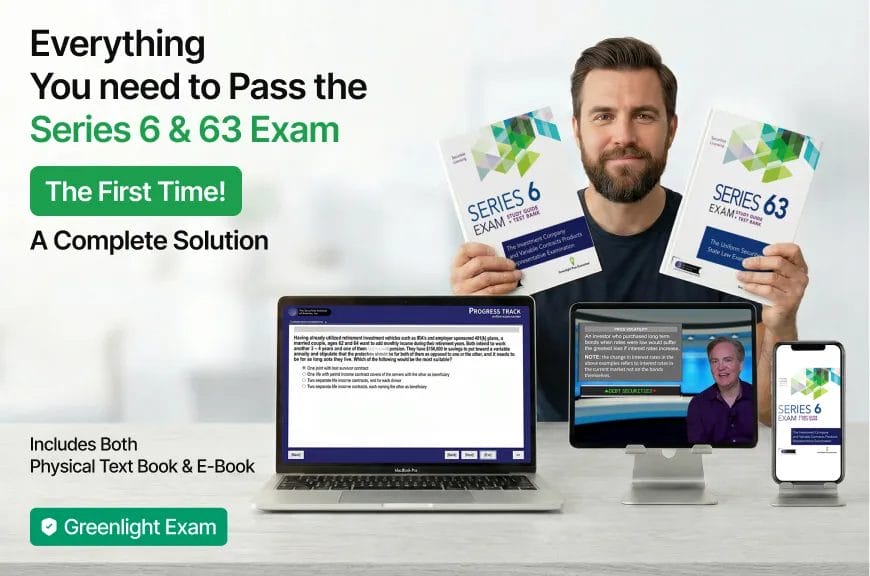
Prepare to pass with the best Series 6 & 63 study materials. Our exam prep course will get you ready for success. With our proven study guides and test secrets. This Training Program ensures you Ace the Series 6 top off exam and the Series 63 Uniform Securities Agent Law exam. In fact , we guarantee you pass. Our best in class securities exam training course features:
17+ hours of video training
2,000+ practice questions with explanations
432-page study guide
Real exam simulation & reports
Personalized study plan

90% Pass Rate
Over 25 years and 400,000 exams

Assured Success
If you use our practice exams

Chat & Call Support
We are with you every step of the way
Authors of the industry leading exam review guides
Creators of the best in class video training courses
Originators of the Greenlight money back pass guarantee
Developers of the most challenging test banks
Buy The Best Series 6 and 63 Exam Prep Study Materials
Video Class Demo
TotalGenius!
Online Account Access
Physical Perfect Bound Textbook
eBook
Video Training Class
Test Bank
Number of Ways to Customize Exams
Comprehensive Question & Exam Reports
Unlimited Randomized Simulated Final Exams
Unlimited Topic Focused Practice Exams
Checkpoint Exams
Greenlight Exam
Exam Plan Personal Study Calendar
Shipping
Online Tools
Test Tips Video to Improve Your Score
Cheat Sheets
Phone Email & Chat Support
Highest pass rate
1 Full year instant access
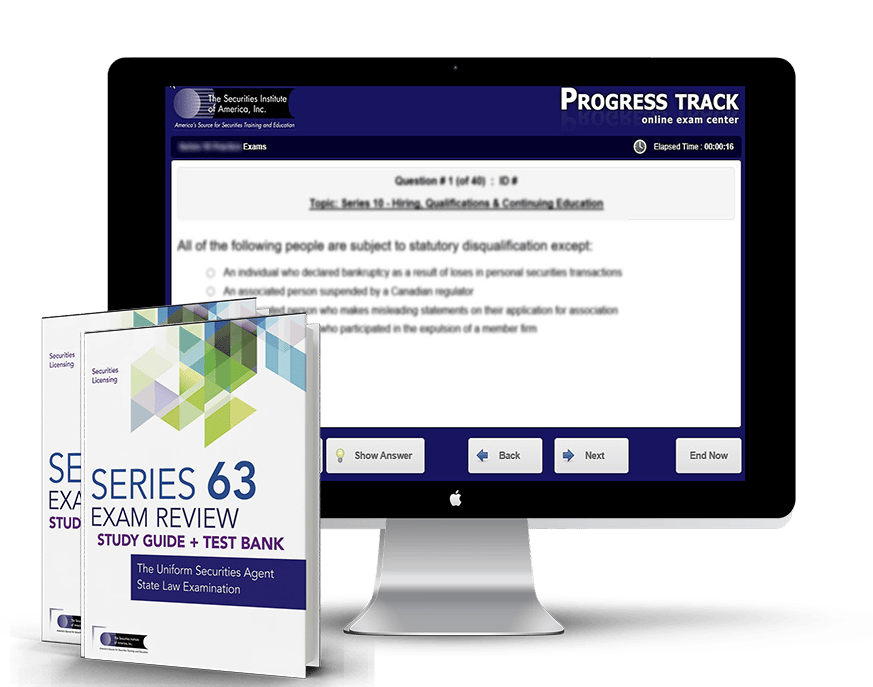
Series 6 Textbook - 384 pages Series 63 Textbook - 215 pages
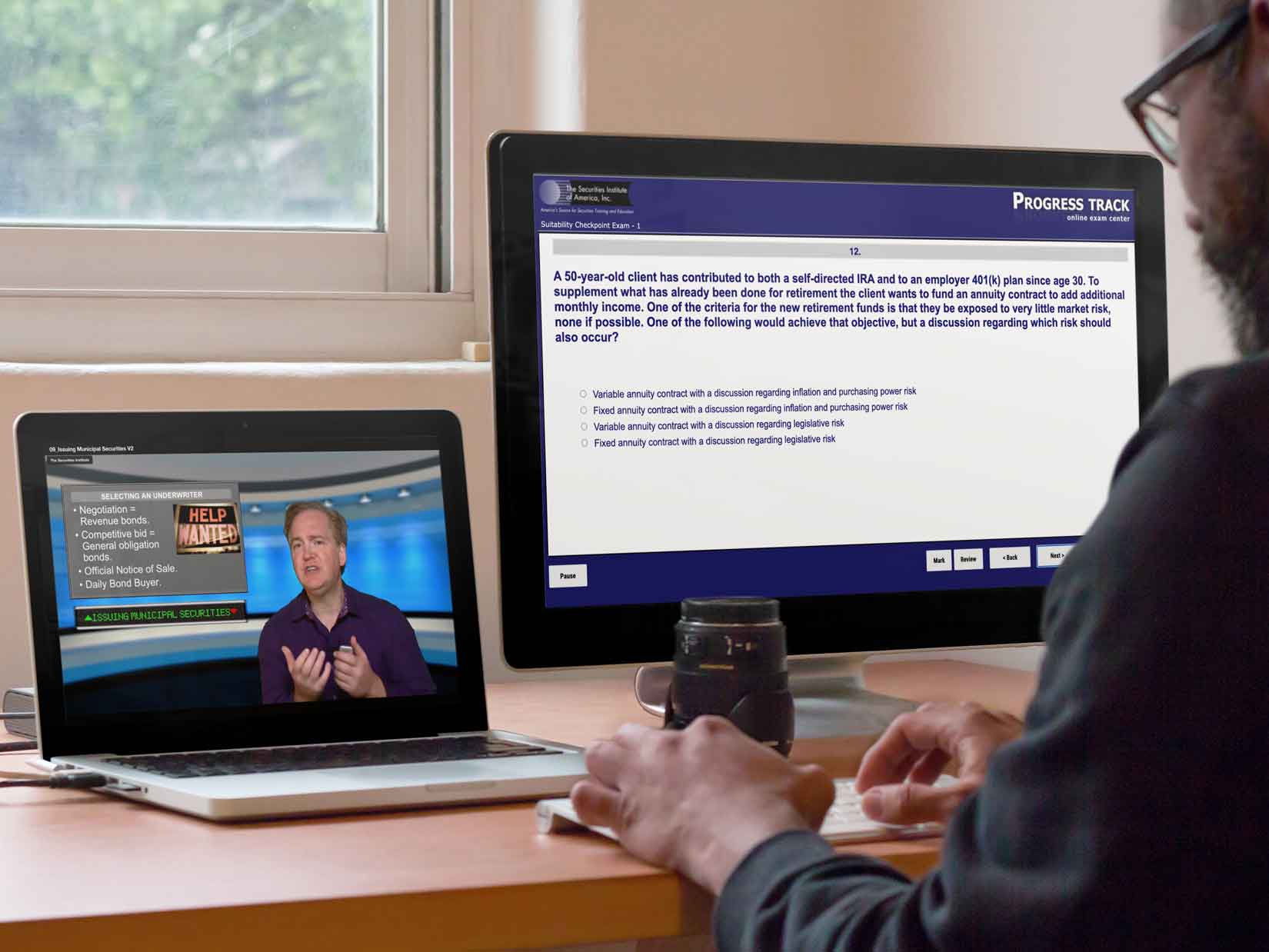
Series 6 Video Class - 10 hours Series 63 Video Class - 4 hours
Series 6 Test bank - 1,200 Questions Series 63 Test bank - 800 Questions
15
Free UPS Shipping. Your tracking number will be emailed to you
Accessible from any computer, phone or tablet
The ultimate shortcut and final crunch time reference guide
$
259.00
Best Value
180 days instant access
Series 6 Test bank - 1,200 Questions Series 63 Test bank - 800 Questions
15
Free UPS Shipping. Your tracking number will be emailed to you
Accessible from any computer, phone or tablet
The ultimate shortcut and final crunch time reference guide
$
174.95
Best additional product
180 days instant access
Series 6 Video Class - 10 hours Series 63 Video Class - 4 hours
Series 6 Test bank - 1,200 Questions Series 63 Test bank - 800 Questions
15
Accessible from any computer, phone or tablet
The ultimate shortcut and final crunch time reference guide
$
179.00
Why Choose
The Securities Institute of America

All-In-One Study System :
We provide a fully integrated learning environment by combining traditional textbooks with state-of-the-art video training and AI-powered tutoring.
High Impact Exam Prep :
Study smarter and learn faster with our TotalGenius! AI-powered platform instant answers, instant guidance, and immediate results.
Experience :
Since our inception in 1995, Securities Exam Prep is all we do. We know what it takes to be successful on exam day and are here to help you every step of the way.
Results :
With more than 400,000 successful students and a pass rate of 90%, we take pride in our results
Frequantly Asked Questions
The Series 6 — Investment Company and Variable Contracts Products Representative license — covers exactly the products you sell. Your bank will also require the Series 63 for state registration, so the Series 6 + 63 combination is the most common path for bank investment center representatives. Most popular path for bank and insurance channel reps. Study time: 6–8 weeks combined.
The Series 6 covers a narrower product set: mutual funds, variable annuities, variable life insurance, and 529 plans. The Series 7 is the general securities representative license — it covers everything Series 6 covers, plus individual stocks, bonds, options, municipal securities, and more. If your role involves selling individual equities or fixed income, you need the Series 7. If it’s strictly funds and variable products, Series 6 is sufficient and faster to obtain.
The Series 65 — Uniform Investment Adviser Law Examination — qualifies you as an Investment Adviser Representative (IAR) for fee-based services. No broker-dealer sponsorship is required to sit for the Series 65, making it the most accessible path for banking professionals transitioning to independent advisory roles or joining an RIA. No firm sponsorship needed. Anyone can take the Series 65 — making it unique among the common licensing exams.
The Series 66 — Uniform Combined State Law Examination. It combines the content of the Series 63 (state agent registration) and the Series 65 (investment adviser law) into a single exam designed specifically for Series 7 holders. The catch: the Series 66 requires a 75% passing score — higher than either the Series 63 (72%) or the Series 65 (70%) alone. Plan for 6–8 weeks of dedicated study.
Almost certainly yes. The Series 63 is required in most states for anyone acting as a securities agent — including Series 6 holders. Only a small number of states do not require it. Your firm’s compliance team will confirm which state registrations apply to your role, but assume you need both unless you’re explicitly told otherwise.
Both licenses qualify you as an Investment Adviser Representative. The Series 65 is a standalone exam — anyone can take it without holding any other license, and it also provides state agent registration in most states when held alone. The Series 66 is a companion exam designed for Series 7 holders — it replaces the need for both the Series 63 and Series 65 by combining their content. If you hold the Series 7, the Series 66 is typically the more efficient path. If you don’t hold the Series 7, take the Series 65.
Yes — the Series 65 requires no prior license and no firm sponsorship. Anyone can sit for it at any time. The Series 6, Series 7, and Series 66 require firm sponsorship by a FINRA-registered broker-dealer or similar entity, but they don’t require you to hold any specific prior license (aside from the Series 66 requiring the Series 7). The SIE may be a co-requirement depending on your registration type — your firm will confirm this.
For most personal bankers transitioning to investment sales within a bank or credit union setting, the Series 6 + Series 63 combination is the right starting point. It’s the fastest path to licensing for the products most commonly sold in that environment (mutual funds, variable annuities, 529 plans), and it’s the licensing requirement most banks and broker-dealer affiliates use for this role. If your bank’s investment program uses a full broker-dealer platform that includes individual stocks, you may be pointed toward the Series 7 instead.
The SIE — Securities Industry Essentials — is FINRA’s foundational exam covering broad securities industry knowledge. For new registrants, it is typically required as a co-requisite or prerequisite for the Series 6 and Series 7. If your firm’s compliance team tells you the SIE is required, study for it first (or concurrently). SIA offers a complete SIE prep course as well, and we can advise on the most efficient sequencing for your situation — call 877-218-1776. The SIE can be taken before you are associated with a firm. It’s valid for 4 years and demonstrates initiative to employers.
Banking professionals typically land in the lower end of the preparation timeline ranges because a meaningful portion of the content — suitability standards, product characteristics, compliance frameworks — overlaps with what you already do. Realistic estimates: Series 6: 4–5 weeks (1–1.5 hours/day). Series 6 + 63: 6–7 weeks. Series 7: 8–10 weeks (1.5 hours/day). Series 65: 5–6 weeks. Series 66: 6–7 weeks. These assume consistent daily study — inconsistent cramming typically takes longer and produces worse outcomes.
For the Series 6: the mechanics of variable annuities and variable life insurance (separate accounts, surrender charges, subaccount allocation rules) and the specifics of mutual fund share classes (A/B/C shares, breakpoints, contingent deferred sales charges) tend to require the most focused study. For the Series 7: options strategies are 15% of the exam and are rarely part of day-to-day banking work — this is the single area that surprises banking candidates most. Municipal bond tax treatment and margin account calculations also tend to require targeted drilling.
Yes — the majority of our students work full time throughout their preparation. Our course is entirely self-paced with no required sessions, and our personal study calendar automatically builds a daily schedule around whatever timeline you give it. Most full-time workers study 1–1.5 hours per day, 5 days per week, and complete preparation within the timeframes above. TotalGenius AI tutoring is available 24/7 if questions come up outside of normal hours.
After 30 years and 400,000+ students, the data is clear: candidates who answer 2,000 or more practice questions before their exam pass at dramatically higher rates than those who answer fewer. For the Series 6 (50 questions, shorter format), a minimum of 1,000–1,500 questions is the floor. For the Series 7 (125 questions), aim for at least 2,500–3,000. Our test banks provide 1,200–3,000+ questions depending on the exam, organized by topic weight so you spend the most time where the exam allocates the most points.
The GreenLight exam is our full-length readiness simulation — built to the same difficulty and topic weighting as the actual FINRA or NASAA exam. It exists to answer one question: are you actually ready to sit, or do you just feel ready? Those are different things. Candidates who pass the GreenLight at our required score threshold have consistently passed the real exam. Every student who passes GreenLight and sits the real exam within 5 days has passed — and that performance is the basis of our money-back guarantee. Pass GreenLight → sit the real exam within 5 days → fail the real exam → we refund your course fee in full. No exceptions in 30 years.
Concurrent study is possible and many candidates do it successfully, but sequential is usually more effective for first-time candidates. Series 6 first (4–5 weeks) followed by Series 63 (2–3 weeks) keeps the content cleaner in your mind — the two exams test very different regulatory frameworks (FINRA product rules vs. NASAA state law), and keeping them separate reduces confusion on exam day. If your timeline is compressed, concurrent study works — just be disciplined about which exam’s questions you’re drilling on any given day.
Yes. Our complete packages include a full video training course — 10–13 hours of video instruction across all topic areas, organized by the same sections as our textbook. The video course shows how each topic is actually tested on the exam, not just what it covers. Many students use the video course as their primary study tool and the textbook as a reference. You can also add TotalGenius AI tutoring for instant on-demand explanations of any concept at any time of day.
Series 6: 70% (35 of 50 scored questions correct). Series 7: 72% (90 of 125 questions). Series 63: 72% (43 of 60 scored questions). Series 65: 70% (91 of 130 questions). Series 66: 75% (67 of 90 scored questions). Note that the Series 66 has the highest threshold of any of these exams — a fact that catches Series 7 holders off guard who assume the combined exam will be easier than either component alone.
For all FINRA exams (Series 6, 7, 66) and NASAA exams (Series 63, 65): 30 days after a first or second failed attempt before you can retest. After a third failed attempt on the Series 65 or Series 66, the wait extends to 180 days (6 months). This escalating wait is why passing on the first or second attempt matters — the cost of a third failure is not just $200–$300 in retake fees, it’s six months of delayed licensing and income. Our GreenLight Guarantee is designed specifically to prevent you from sitting before you’re ready — reducing the risk of hitting the 6-month wait.
FINRA exams (Series 6, 7, 66) and NASAA exams (Series 63, 65) are administered at Prometric testing centers. You schedule through FINRA’s registration system after your firm submits your Form U4 (or, for the Series 65, after you submit a Form U10). Most metro areas have multiple Prometric centers with appointments available within a few days of your target date. You receive your pass/fail result immediately on screen at the end of the exam.
FINRA licenses (Series 6, 7, 66) remain active as long as you are registered with a FINRA-member firm. If you leave the industry and are not associated with a member firm for more than two years, your license lapses and you must requalify by re-examination. The Series 65 (and state registrations) are maintained through annual continuing education — NASAA’s IARCE program requires 12 credit hours per year including 6 in ethics.
Yes. FINRA’s Regulatory Element CE is now required annually (the rule changed in 2023 from every 3 years). Your firm’s Firm Element CE is also required annually. State-registered IARs (Series 65 or 66 holders) must complete 12 IARCE credit hours per year including 6 in ethics to maintain their IAR registration. SIA offers complete IARCE CE courses — call 877-218-1776 for details.
If you leave mid-process, the impact depends on where you are. If you’ve passed the SIE, it remains valid for 4 years regardless of employment — it’s portable. If you’ve passed the Series 6 or Series 7, those licenses are associated with your registration and will go dormant once you’re no longer associated with a FINRA member firm — but they don’t disappear immediately. You have up to two years to associate with another firm before they lapse. The Series 65 and any state registrations are similarly portable if you maintain them through CE requirements.
The income difference varies significantly by role and firm type, but licensed financial advisors and registered representatives consistently earn more than unlicensed banking staff in equivalent seniority levels. Series 6/63-licensed bank investment center reps typically earn base salaries comparable to senior personal bankers plus commission on product sales. Series 7-licensed registered reps at broker-dealer affiliates or independent firms often earn primarily through commission or asset-based fee income, with total compensation scaling directly with the assets they manage and clients they serve. Series 65-licensed IARs charging AUM fees can build scalable, recurring income as their assets under management grow.
Yes — many advisors start their licensing journey inside a bank or broker-dealer affiliate, then move to an independent RIA or broker-dealer once they’ve built experience and a client base. Your licenses are yours, not your employer’s (subject to the two-year activity requirement for FINRA licenses). The Series 65 in particular is popular among banking professionals planning an eventual move to independent advisory work because it doesn’t require ongoing firm affiliation to maintain, unlike the Series 6 or 7.
Significantly. Candidates who walk into interviews with a securities license — particularly the Series 65 (which requires no sponsorship to obtain) or a passed SIE — stand out immediately in a hiring pool where most applicants have zero licensing credentials. Hiring managers at broker-dealers and RIAs view a pre-existing license as evidence of both initiative and genuine career commitment. It also removes a compliance timeline concern for the hiring firm — they can onboard you faster. The Series 65 can be obtained before any job offer. Many banking professionals use it specifically to accelerate their transition to advisory roles.
With a Series 6 + 63, you’re qualified to work as a registered representative selling investment company products and variable contracts. Common roles: bank investment center representative, financial services representative at a bank or credit union, mutual fund sales representative, variable annuity specialist at an insurance company or bank affiliate. The Series 6 does not authorize you to sell individual stocks or bonds — if those are part of the role, you need the Series 7.
For FINRA exams (Series 6, 7, 66), banking experience doesn’t substitute for any formal prerequisites — the requirements are firm sponsorship plus any co-requisite exams (SIE in some cases). For the Series 65 and Series 63, no experience requirement exists at all — NASAA exams are open to anyone who passes them. Some states allow holders of the CFP, CFA, ChFC, or other professional designations to waive the Series 65 requirement — but banking titles alone don’t qualify.
Many banks and broker-dealer affiliates cover the cost of exam preparation materials for employees they are licensing — it’s in their interest to maximize first-attempt pass rates and minimize the productivity loss from delayed licensing. Ask your manager or HR team before purchasing. If your employer doesn’t cover it, the cost of a complete prep package ($199–$329) is typically tax-deductible as a work-related education expense — consult a tax advisor for your specific situation.
You need your sponsoring firm to register you for the Series 7 — you can’t sit for it independently. If your current bank only offers Series 6 sponsorship, you have two options: (1) discuss with your manager or compliance team whether Series 7 sponsorship is available for your role or a transfer to a different role within the bank, or (2) seek employment at a broker-dealer or RIA that offers Series 7 sponsorship. In the meantime, passing the SIE (which you can do without sponsorship) gives you a meaningful credential that demonstrates readiness for the Series 7.
Firm sponsorship means your employing broker-dealer or FINRA-member firm submits a Form U4 (Uniform Application for Securities Industry Registration) on your behalf through the FINRA Central Registration Depository (CRD). The U4 creates your registration window, which allows you to schedule and sit for the Series 6 or Series 7. Your firm essentially vouches for you with FINRA and takes on supervisory responsibility for your securities activities. You cannot self-register for these exams — firm affiliation is required.”
Absolutely — and you should. Enrolling in your prep course before your U4 is submitted means you can be exam-ready the moment your registration window opens. Most firms have a backlog in compliance processing, and candidates who wait until their U4 is submitted before starting to study lose 2–4 weeks of preparation time. Start studying immediately after confirming which exam your employer is registering you for. Early starters consistently have more comfortable exam experiences and higher first-attempt pass rates.
Every complete self-study package includes: the full exam prep textbook (physical and eBook editions), the complete question test bank with 1,200–3,000+ practice questions depending on the exam, a full video training course (10–13 hours), checkpoint and topic-focused practice exams, unlimited randomized simulated final exams, the GreenLight readiness exam, a personal study calendar, phone and email support from our team, TotalGenius AI tutoring, and 180 days of instant access from any device. Free UPS shipping on physical materials. All packages come with the GreenLight Money-Back Guarantee. Pass GreenLight, sit the real exam within 5 days, fail — we refund you in full.
TotalGenius is SIA’s AI-powered on-demand tutoring system — the first of its kind in securities exam preparation. It’s available 24 hours a day, 7 days a week, and can answer any question about the exam material instantly with instructor-quality explanations. Unlike a human tutor who needs to be scheduled, TotalGenius is there when you’re studying at 10pm after a full day at the bank and hit a question you can’t work out. It’s included in all complete self-study packages.
You can switch at any point. Many of our strongest students come to us after using another provider’s materials — sometimes mid-prep, sometimes after a failed attempt. If you’re mid-prep, our course integrates cleanly: our test bank questions are organized by topic, so you can focus immediately on your weak areas without starting over from the beginning. If you failed with another provider’s materials, our complete package replaces what you had — and your prep timeline for the retake resets around our structured plan. Call 877-218-1776 and we’ll help you assess where you are and what the right move is.
Three options exist for each exam: (1) Complete Self-Study Solution — textbook + question bank + video course + GreenLight exam, our highest pass rate package and the one we recommend for most candidates. (2) Textbook + Exam Prep Software — textbook and question bank only, no video, best for candidates who learn through reading and drilling. (3) Complete Video Package — video course and question bank, no physical textbook, best for visual learners. If you’re unsure, call 877-218-1776 — we’ll ask a few questions about how you typically learn and point you to the right option. The complete package is right for the majority of candidates, especially those who haven’t studied formal exam material recently.
From Personal Banker to Licensed Broker: The Fast Track Guide
How the licensing process works from here
Confirm your exam with your employer’s compliance team
Your bank or broker-dealer’s compliance department will tell you exactly which exam(s) you need and whether they will sponsor your registration (required for Series 6, 7, and 66). Get this confirmed before enrolling in a prep course so you study for the right exam.
Enroll in your prep course and build a study schedule
Our complete packages include a personalized day-by-day study calendar built around your timeline. Series 6 and 65 candidates typically need 4–6 weeks of consistent study (1–1.5 hours/day). Series 7 candidates typically need 8–12 weeks. Series 66 candidates typically need 6–8 weeks.
Drill practice questions by topic — not random
The most predictive factor in first-attempt pass rates is practice question volume organized by topic weight. Our test bank sorts questions by the same topic proportions FINRA and NASAA use — so you spend the most time on the areas that make up the most of your score.
Pass the GreenLight exam before you book the real one
Our GreenLight readiness exam is a full-length simulation at real exam difficulty. It tells you honestly whether you’re ready to sit — not just whether you feel ready. Every student who passes the GreenLight at our required threshold has passed the actual FINRA or NASAA exam. That’s the basis of our money-back guarantee.
Sit the exam and receive your license
FINRA exams are administered at Prometric testing centers nationwide. NASAA exams (Series 63, 65, 66) are also at Prometric. You receive your score immediately after completing the exam. Your firm’s compliance team handles your FINRA or state registration after you pass.